Article visual
The guide in one frame.
Four Seasons Resort Koh Samui has no standard hotel rooms — all 71 keys are hillside pool villas built into a former coconut orchard, with a working Muay Thai ring and an elemental-philosophy spa.
Four Seasons Resort Koh Samui has no standard hotel rooms — all 71 keys are hillside pool villas built into a former coconut orchard, with a working Muay Thai ring and an elemental-philosophy spa. Here's what that structure actually changes.
Paid partner link - VIAIVE may earn compensation at no additional cost to you.
Most beach resorts sell a private pool as the top-tier upgrade — the thing you pay more to get, sitting a few room categories above the standard king with a view of the parking court.
Four Seasons Resort Koh Samui removes that ladder entirely. There is no standard room here. All 71 accommodations, from the smallest one-bedroom Serenity Pool Villa to the largest five-bedroom Private Residence, come with a private infinity pool as the baseline, not the reward for spending more. That's a structural decision, not a marketing line, and it shapes almost everything else about how the property is built and how a stay inside it actually runs.
Most beach resorts sell a private pool as the top-tier upgrade — the thing you pay more to get, sitting a few room categories above the standard king with a view of the parking court.
No Standard Rooms works best when the specifics above match the trip; when they don’t, use Plan With VIAIVE rather than treating this as a final call.
Paid partner link - VIAIVE may earn compensation at no additional cost to you.
| Decision point | Primary path | Alternative path |
|---|---|---|
| Traveler decision | Most beach resorts sell a private pool as the top-tier upgrade — the thing you pay more to get, sitting a few room categories above the standard king with a view of the parking court. | Use correspondence when the itinerary has constraints the public page cannot resolve. |
| Best use case | Introduction | Building on a working orchard instead of clearing it |
| Commercial path | Use disclosed partner modules when public rate windows matter. | Use VIAIVE correspondence when the placement, room category, or routing needs human judgment. |
Four Seasons Resort Koh Samui has no standard hotel rooms — all 71 keys are hillside pool villas built into a former coconut orchard, with a working Muay Thai ring and an elemental-philosophy spa.
Four Seasons Tented Camp Golden Triangle sells stays as two-, three-, or four-night all-inclusive packages, not nightly rates.
Four Seasons Resort The Nam Hai has no standard hotel rooms — all 100 accommodations are private villas on Ha My Beach, between Hoi An's old town and Da Nang.
Four Seasons Resort Chiang Mai is built around an active rice farm in the Mae Rim Valley — guests plant rice, bathe water buffalo, and breakfast in the fields.
19 July 2026
VIAIVE verifies current reservation status, chef or programme changes, and neighborhood fit before naming a dining decision.
Disclosed Stay22 partner paths appear once near the close of the guide, with sponsored nofollow labeling and affiliate disclosure.
Four Seasons Resort Koh Samui has no standard hotel rooms — all 71 keys are hillside pool villas built into a former coconut orchard, with a working Muay Thai ring and an elemental-philosophy spa. Here's what that structure actually changes.
Most beach resorts sell a private pool as the top-tier upgrade — the thing you pay more to get, sitting a few room categories above the standard king with a view of the parking court. Four Seasons Resort Koh Samui removes that ladder entirely. There is no standard room here. All 71 accommodations, from the smallest one-bedroom Serenity Pool Villa to the largest five-bedroom Private Residence, come with a private infinity pool as the baseline, not the reward for spending more. That's a structural decision, not a marketing line, and it shapes almost everything else about how the property is built and how a stay inside it actually runs.
Most beach resorts sell a private pool as the top-tier upgrade — the thing you pay more to get, sitting a few room categories above the standard king with a view of the parking court. Four Seasons Resort Koh Samui removes that ladder entirely. There is no standard room here. All 71 accommodations, from the smallest one-bedroom Serenity Pool Villa to the largest five-bedroom Private Residence, come with a private infinity pool as the baseline, not the reward for spending more. That's a structural decision, not a marketing line, and it shapes almost everything else about how the property is built and how a stay inside it actually runs.
The resort sits on the northwestern coast of Koh Samui, on what was previously a coconut orchard. Rather than clearing the land for a conventional footprint, the builders retained 856 of the site's original coconut trees through construction, and the property opened in February 2007 to a design from Bensley Design Studios rooted in traditional southern Thai architectural forms. The result is a hillside layout rather than a flat, walkable strip: villas are staggered up the slope above the resort's private beach — the only stretch of private beach access on the island — connected by paths and buggy routes rather than a single ground-floor corridor. Guests who want to walk straight out of their room onto sand, the way they might in Chaweng or Bophut, will find the geography works differently here; the beach is a destination you travel down to, not the villa's own front yard, with the exception of the Beachfront Pool Villa category, which sits low enough to open directly onto a beach-facing deck.
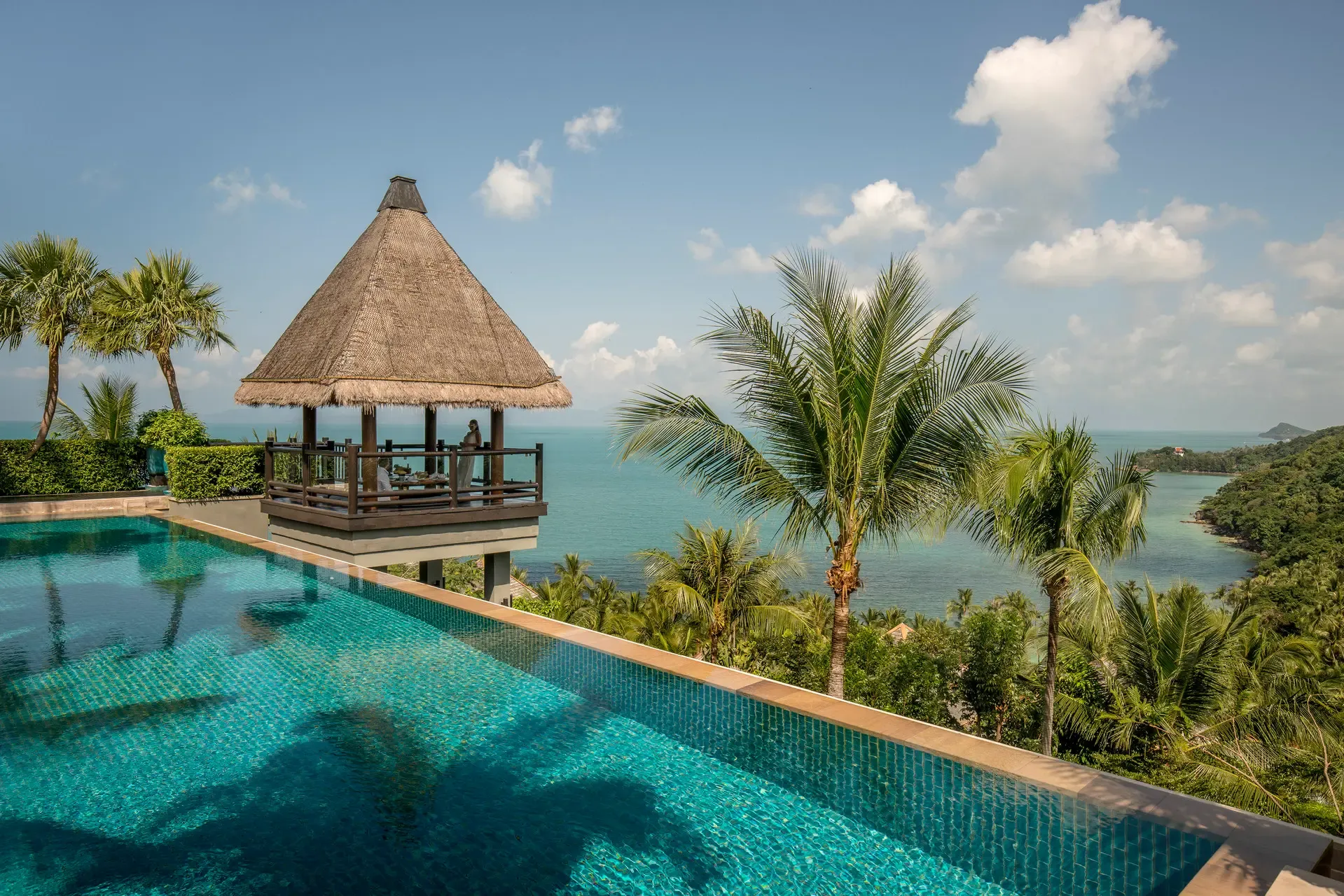
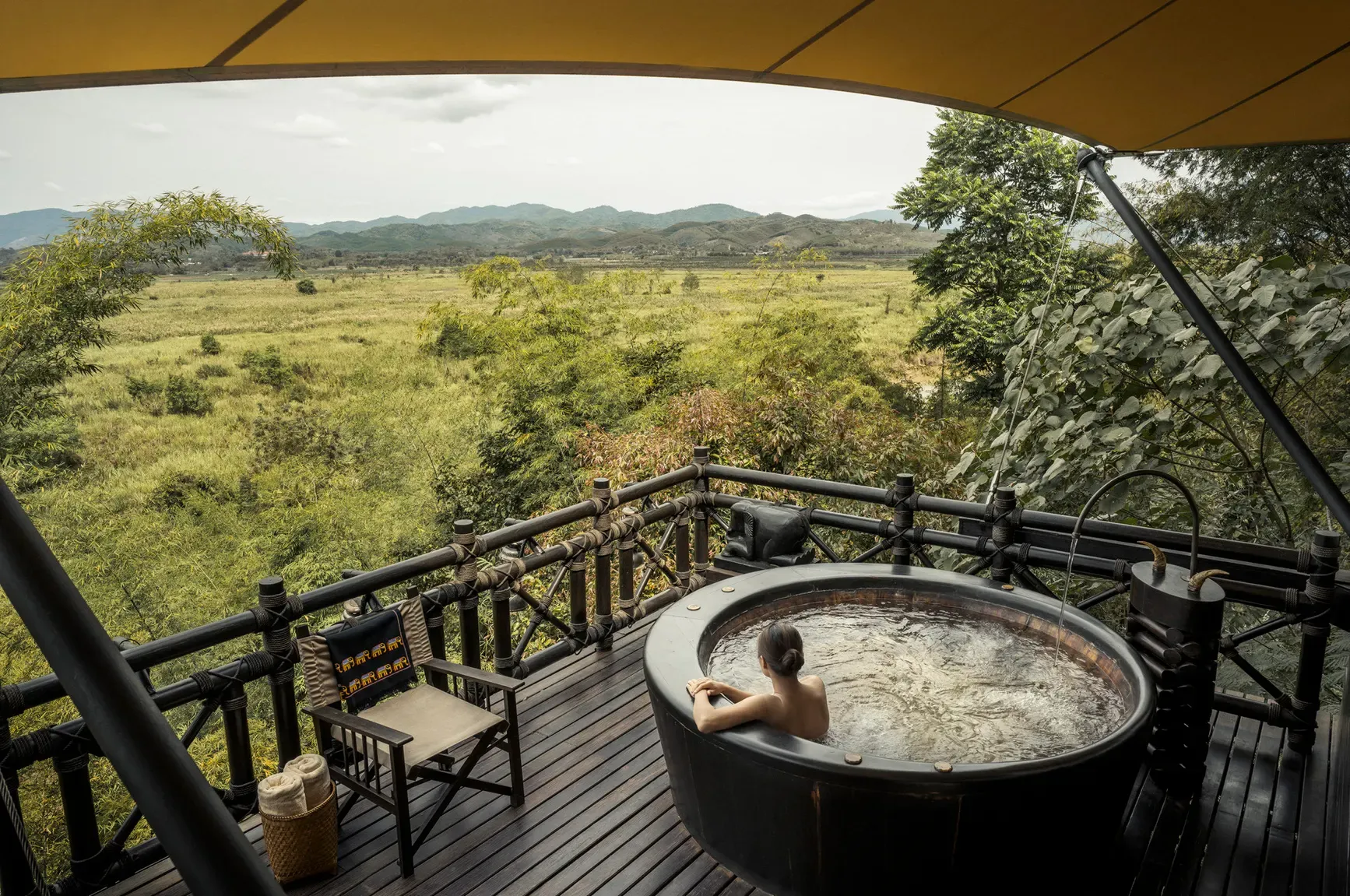
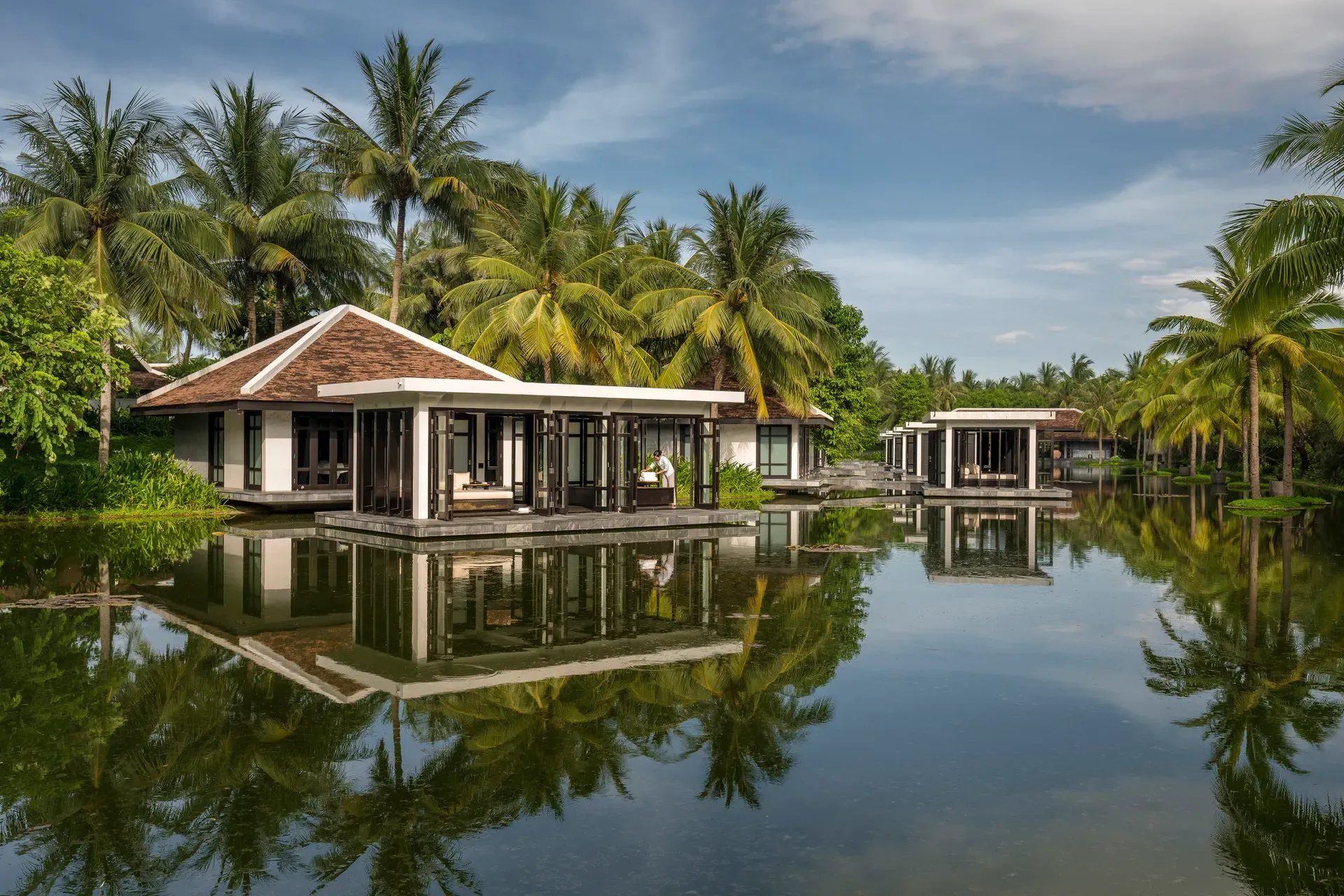
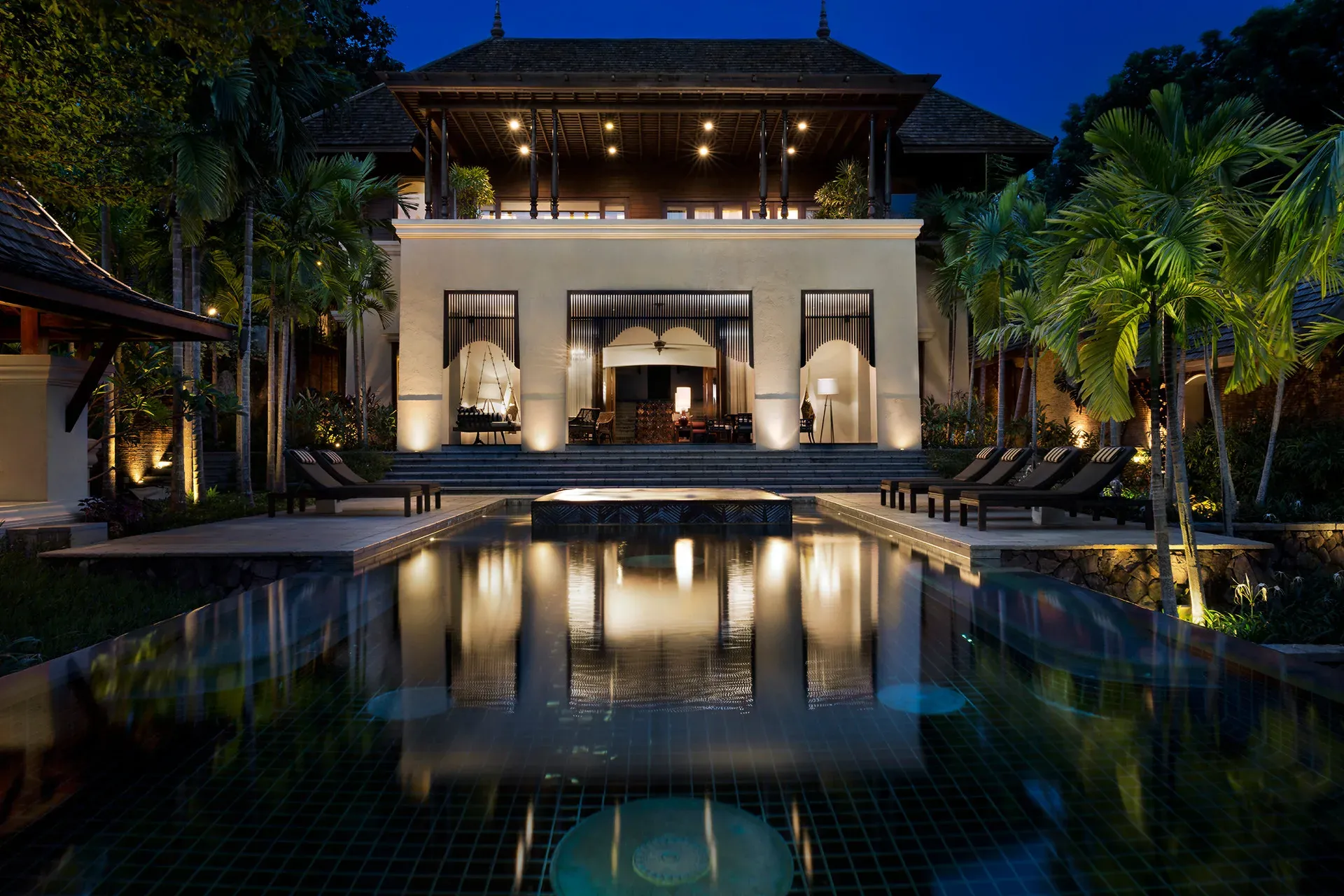
Splitting the full 71-key count between 60 pool villas and 11 Private Residence villas means every stay, regardless of category, comes with a private outdoor space rather than a balcony over a shared pool deck. The one-bedroom Serenity and Island Ocean Pool Villas run 103 square metres with their own 15-square-metre infinity pools; the Premier Ocean View Pool Villa steps the pool up to 25 square metres. The Family Pool Villa, at 118 square metres, adds a second bedroom with twin beds, its own television, and a set of games — built specifically for couples traveling with children up to age 12 who want the kids nearby but in a distinct space, not folded into the parents' room. At the top of the range, the Private Residences run one to five bedrooms, each with a live-in personal residential assistant, daily breakfast, and a full kitchen, holding up to 15 guests in the largest configurations; the Four-Bedroom Hillside Residence adds a second private pool and an open-air dining pavilion on top of that. The practical effect is that a family reunion, a multi-generational group, or a wedding party can book one unit with real separation between families rather than negotiating four or five adjoining hotel rooms.
The clearest signal that this resort was built around a specific idea rather than a standard amenities checklist is its Muay Thai ring — a professional-grade outdoor boxing ring set on a hilltop overlooking the Gulf of Thailand, where guests can take lessons directly from professional fighters or join a structured bootcamp. It sits alongside a more conventional roster of on-site activity — two tennis courts, yoga, kayaking, snorkeling, and interactive Thai cooking classes with the resort's own chefs — plus off-site options including scuba diving, golf, mountain biking, and boat trips into Angthong Marine Park's 42 islands. But the ring is the one piece of programming that couldn't be swapped into any beach resort in Southeast Asia without feeling out of place; it's a specifically Thai physical tradition, given a dedicated piece of real estate rather than a corner of the fitness centre.
The Secret Garden Spa carries the same specificity. Its five treatment rooms sit inside a coconut grove, with a separate Secret Beach Spa sala positioned at the ocean's edge for treatments taken to the sound of the water rather than air conditioning. The treatment menu is organized around Tard Chao Ruan, the Thai concept of four elements — Din (Earth), Nam (Water), Lom (Air), and Fai (Fire) — with each signature treatment built to address a different one: Earth Energy Four Hands, Samui Fusion, and Kala Coconut, a massage built around coconut oil and shell, among others. It reads less like a spa menu assembled from an international treatment catalogue and more like a program designed specifically for this coastline and this cultural context.
This structure rewards a specific kind of traveler: someone who wants a private pool as a given rather than an upsell, a family or multi-generational group that needs real separation between units, or anyone drawn to Thai-specific programming — the Muay Thai ring, the elemental spa concept — over a generic international resort template. It's a weaker fit for a traveler who wants to walk out of a room straight onto a lively beach boardwalk, or who prefers a large-scale resort with a big central pool deck and a busy lobby scene; the hillside layout and the buggy transfers are a deliberate trade against exactly that kind of energy, in favor of privacy built into the base product rather than sold as an add-on.
Four Seasons Tented Camp Golden Triangle sells stays as two-, three-, or four-night all-inclusive packages, not nightly rates. Here's what that structure actually buys, and how to choose a length.
Four Seasons Resort The Nam Hai has no standard hotel rooms — all 100 accommodations are private villas on Ha My Beach, between Hoi An's old town and Da Nang. Here's what that structural choice actually changes about a stay.
Four Seasons Resort Chiang Mai is built around an active rice farm in the Mae Rim Valley — guests plant rice, bathe water buffalo, and breakfast in the fields. Here's why the setting, not the room category, is the real decision.
Field Intelligence Letter
A short monthly note on hotel openings, route shifts, seasonal timing, and the stay decisions worth making early.
One letter per month. Unsubscribe at any time. No sharing, no resale. Privacy Policy.
When a piece here makes you want to move, write the first few lines.
Plan With VIAIVE ↗