Best for
Travellers who want a calm, deeply Thai garden hotel in central Bangkok with strong Sathorn and Silom access and standout on-property dining.
Choose The Sukhothai for a serene garden retreat in central Sathorn with unusually deep on-property dining; look elsewhere for a riverside address or a high-floor skyline room. Best for: Travellers who want a calm, deeply Thai garden hotel in central Bangkok with strong Sathorn and Silom access and standout on-property dining. The Sukhothai Bangkok is a low-rise, garden-style luxury hotel on South Sathorn Road — lily-pond courtyards, teak-and-silk interiors inspired by the Sukhothai kingdom, MICHELIN Guide-listed dining, and a calm central location minutes from the BTS and MRT.
01 · Bangkok, Thailand · Hotel
The Sukhothai Bangkok is a low-rise, garden-style luxury hotel on South Sathorn Road — lily-pond courtyards, teak-and-silk interiors inspired by the Sukhothai kingdom, MICHELIN Guide-listed dining, and a calm central location minutes from the BTS and MRT.
The short answer
Choose The Sukhothai for a serene garden retreat in central Sathorn with unusually deep on-property dining; look elsewhere for a riverside address or a high-floor skyline room.
Paid partner link - VIAIVE may earn a commission at no additional cost to you.
02 · Property photographs
5 photos
Press image courtesy of The Sukhothai Bangkok
Finish the image set, then check current rates for your dates.
Paid partner link - VIAIVE may earn a commission at no additional cost to you.
03 · Keep or skip
The trade-off stays visible before the longer evidence read.
Best for
Travellers who want a calm, deeply Thai garden hotel in central Bangkok with strong Sathorn and Silom access and standout on-property dining.
Avoid if
You specifically want a riverside address, a high-floor skyline view, or a buzzy, design-forward party scene.
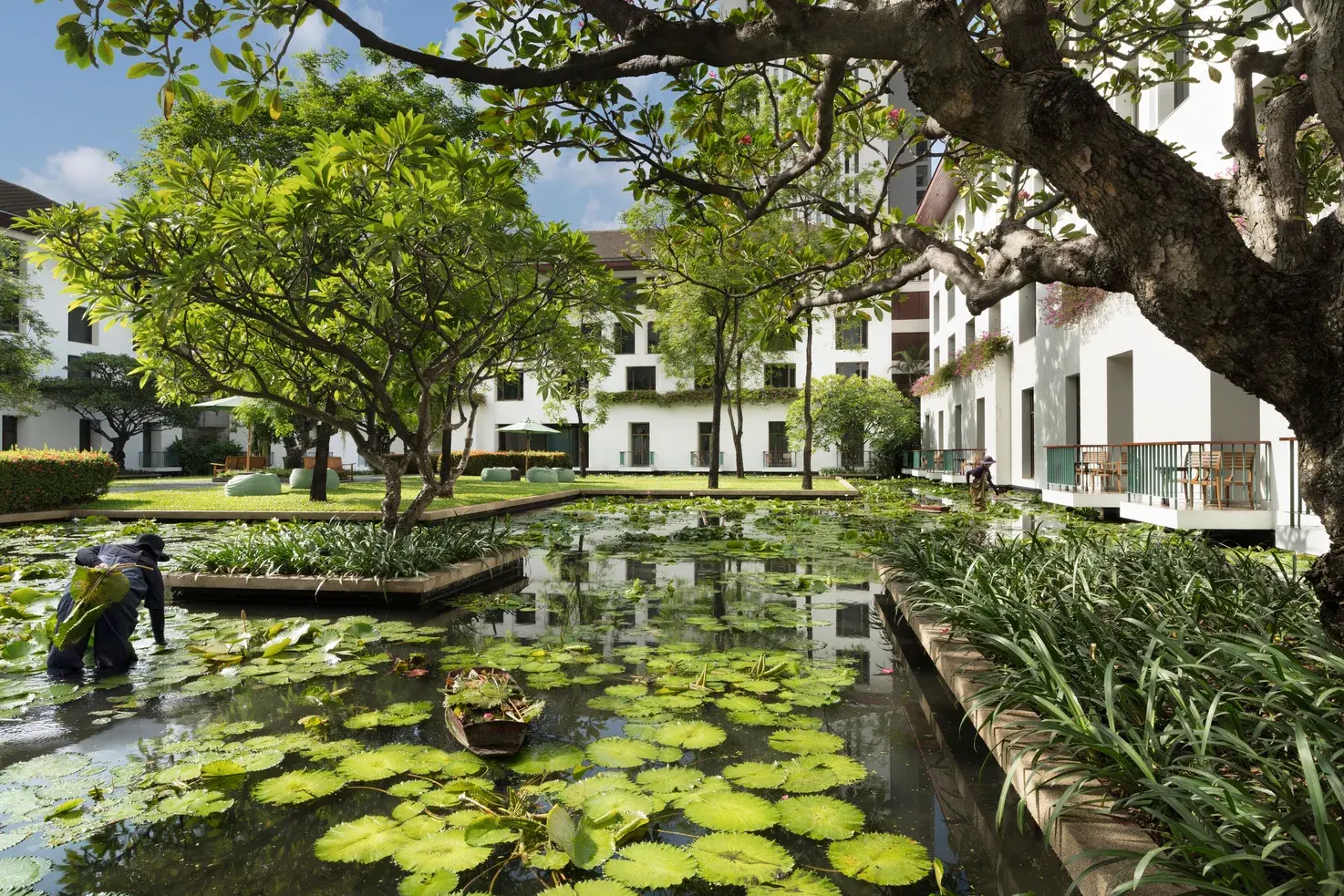
The Sukhothai Bangkok opened in November 1991 on South Sathorn Road, within the city's central business and embassy district. Its defining idea is restraint: the buildings are held to a modest nine storeys, and the low wings wrap around lawns, porticoed walkways and a run of reflecting lily ponds set with scale replicas of ancient Thai chedi. The result is a village-like calm that is unusual for central Bangkok: a garden you walk through, not a tower you look out from. The location does the practical work quietly. BTS Skytrain and MRT stations sit within a few minutes of the door, Lumpini Park and the Silom business core are close by, and the Chao Phraya river, the grand palaces and the city's shopping districts are a short ride away. You get a genuine retreat without giving up the connectivity that makes Bangkok easy to work.
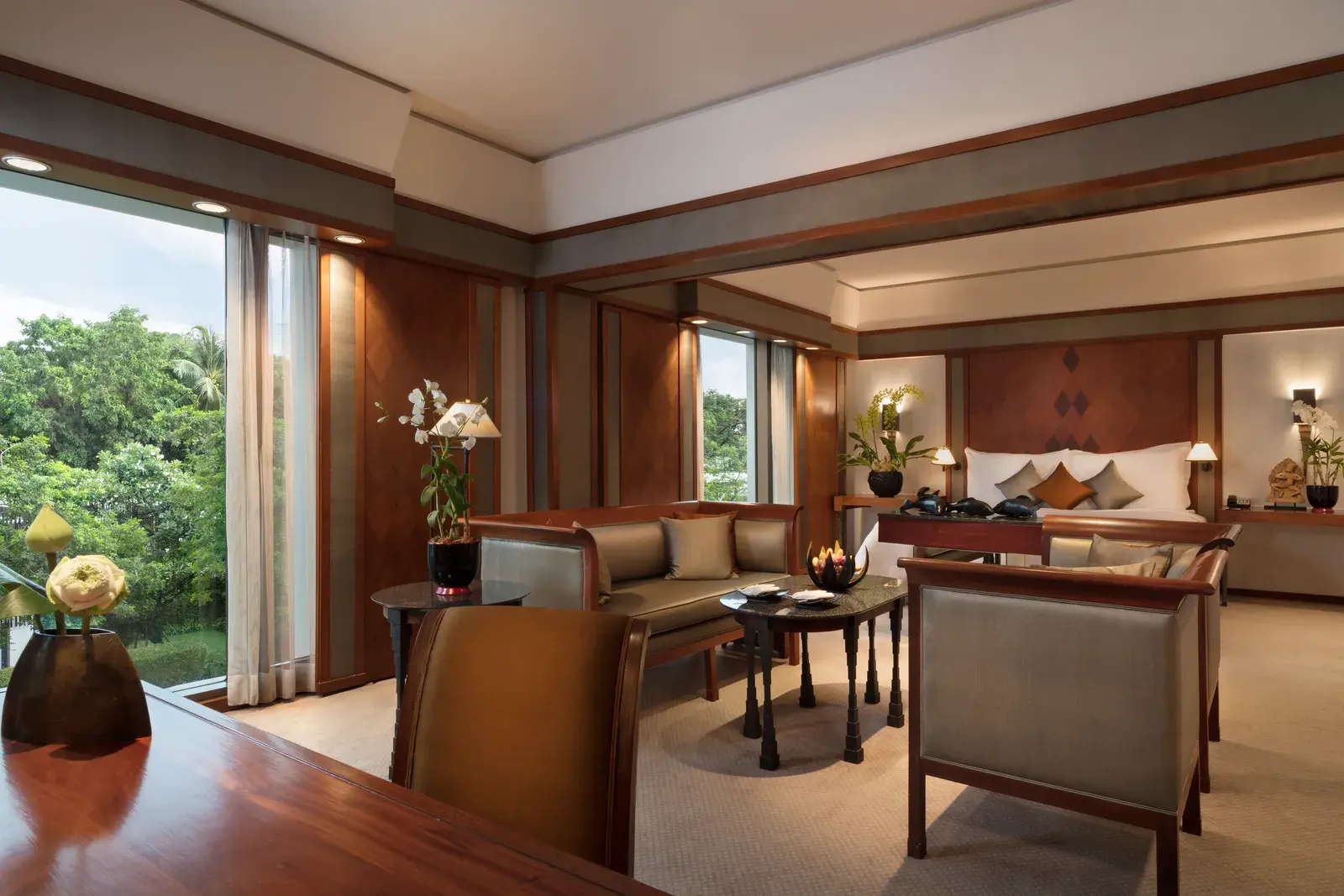
The hotel takes its name, and its entire visual language, from the Sukhothai kingdom, the 13th- to 14th-century era widely regarded as Thailand's golden age of art and architecture. The interiors lean on a tight palette of natural materials: water silk, glass, wood and granite, with polished teak and mirror detailing running through the rooms and public spaces. Chedi forms recur as sculptural objects resting in the reflecting pools, a motif that ties the modern building back to the temples and palaces that inspired it. The silk is a signature in its own right: the draperies, wall coverings and upholstery use fabric from Jim Thompson, the Thai house whose silk is regarded as among the finest in the region, in custom hues created for the hotel over a relationship spanning more than a quarter century. It is a coherent, deeply Thai interior that has aged well precisely because it never chased a passing trend.
Accommodation is spread across roughly 210 rooms and suites in two distinct wings. The Main Wing holds the core categories, from the 38-square-metre Deluxe Queen and Deluxe Twin up through a deep bench of 76-square-metre suites, including the Executive, Deluxe and Garden Suites, and the singular 198-square-metre Sukhothai Suite. The Club Wing is the more residential, more private option: Club rooms and suites, from the 45-square-metre Club King to the 138-square-metre Club Balcony Suite, come with access to a dedicated club lounge, deluxe breakfasts, all-day refreshments, evening hors d'oeuvres and an open bar, with the rooms and lounge oriented toward the pool and gardens. Whichever wing you choose, the rooms share the same teakwood, silk and understated Thai detailing. The difference comes down to lounge access, space and privacy, not décor. The room-by-room breakdown is in the companion room guide below.
Few Bangkok hotels punch above their room count at the table the way The Sukhothai does. Celadon, the flagship Thai restaurant, sits in a pavilion over the grounds and is listed in the MICHELIN Guide; it serves classical Thai cooking and stages traditional Thai dance in the evening. La Scala is the Italian-Mediterranean counterpoint, a poolside room with an open kitchen and a private cellar, also recognised in the MICHELIN Guide, pairing a European menu with fine wines. The Colonnade, overlooking the illuminated Chedi pond, is the all-day international restaurant and the home of a long-running Sunday champagne brunch that has become a fixture of the Bangkok calendar. Around them sit the Lobby Salons, with afternoon tea and a chocolate buffet; the Pool Terrace Café & Bar; the Zuk Bar, overlooking the courtyard garden; and Thimian, a gourmet café for pastries and coffee. For a guest who wants to eat well without leaving the property, the range is genuinely deep.
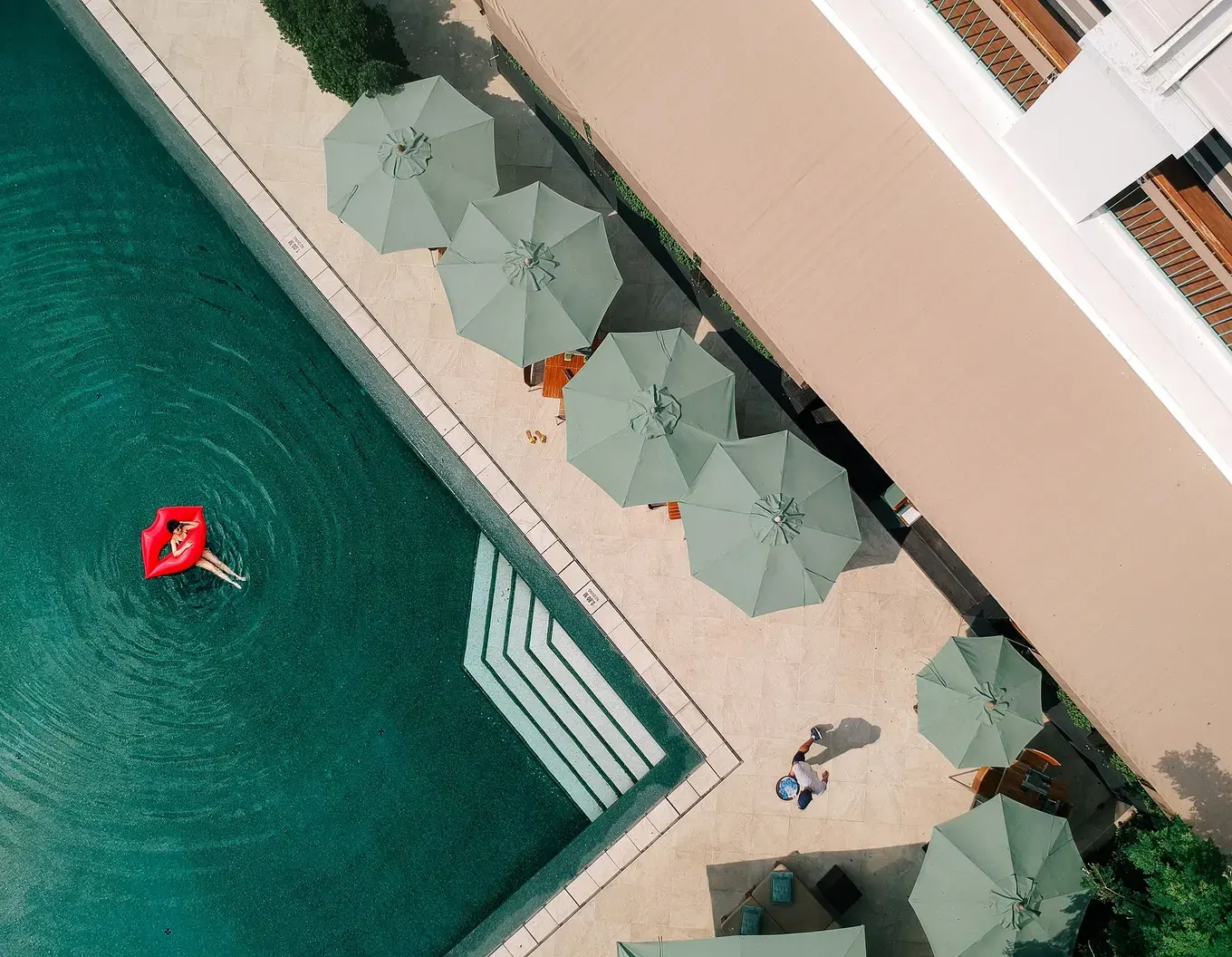
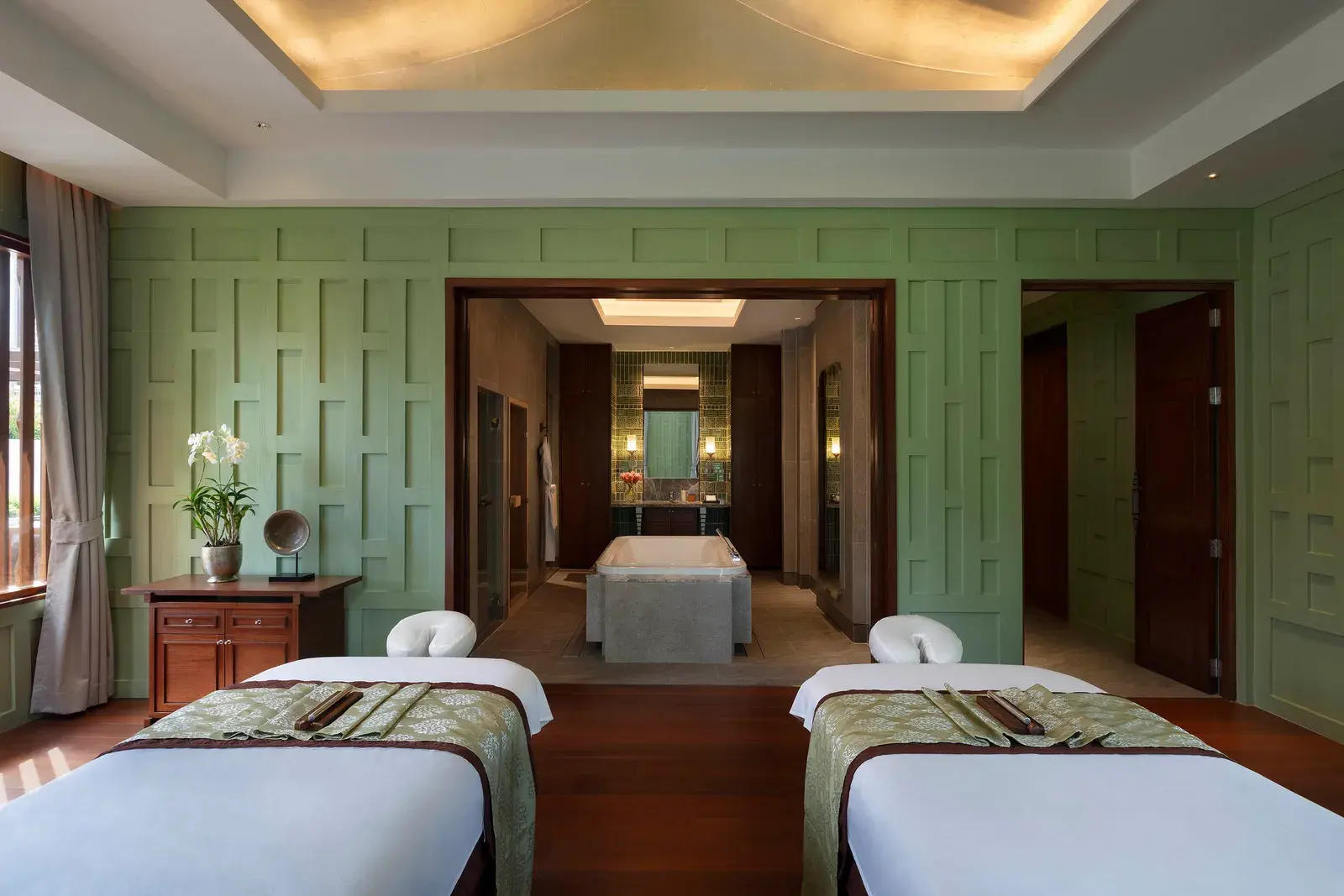
Wellness is built into the layout, not bolted on. The Sukhothai Spa, its façade drawing on the temple architecture of Wat Sri Chum, runs a full menu of massage, beauty and hammam treatments alongside yoga, Pilates and meditation, with a salt-water outdoor pool, hot tubs, saunas and steam rooms; it keeps long hours, opening daily from morning until late in the evening. The main draw outdoors is a 25-metre outdoor infinity pool ringed by private cabanas and deck seating, set in the same garden that defines the rest of the hotel. A fitness studio with current cardiovascular and strength equipment rounds out the offer. None of it is engineered for spectacle. All of it reinforces the sense that this is a place designed to slow down a Bangkok trip.
Introduction: Bangkok, as a luxury proposition, mostly climbs. The city's marquee hotels tend to announce themselves vertically: a lobby on a high floor, a pool cantilevered over the skyline, a view sold by altitude. The Sukhothai Bangkok makes the opposite argument. It spreads. And the more time you spend thinking about what a Bangkok stay is actually for, the more that horizontal argument holds up.
An address that asks you to look down, not out: The hotel sits at 13/3 South Sathorn Road, in the Thungmahamek pocket of Sathorn, the capital's central business and embassy district. It is a serious, quiet address: close to Lumpini Park, a short move from Silom Road, within reach of the Chao Phraya River, and rail-connected through BTS Sala Daeng and MRT Lumpini. On paper that is a location built for a tower. What sits on it is a low-rise property that turns its attention inward and downward, to courtyards, colonnades, and water, rather than up toward a skyline it could easily have chased.
That choice is the whole point. In a district where nearly every neighbour competes for the same view of the same horizon, The Sukhothai declines the contest and offers something the towers structurally cannot: ground. Real, planted, walkable ground, laid out around reflecting ponds.
The heritage the design is actually quoting: The name is not decorative. The hotel's design draws directly on the ancient city of Sukhothai, the thirteenth-to-fourteenth-century Thai kingdom whose ruined chedis and pagodas remain some of the most recognisable silhouettes in Thai art. The property describes its own architecture, in its own words, as "a careful rendition of the magnificent Chedis and pagodas reminiscent of that graceful age." Those forms are not relegated to a lobby mural. They are built into the grounds as structure, a Chedi Pond among them, so that the reference reads as landscape rather than motif.
This is what separates heritage-led design from heritage-themed design. A themed hotel borrows a few visual cues and applies them to a conventional building. The Sukhothai instead lets the reference dictate the massing: low, spread, organised around water and open colonnade, the way the temple complexes it quotes actually were. The result is a property the hotel frames as "the marriage of tradition with modern sophistication" and an "urban oasis in a living metropolis," phrasing that would be marketing puff at a high-rise but reads here as a fair description of the physical experience of walking the grounds.
Water as the organising idea: If there is a single detail that carries the whole argument, it is the ponds. The clearest expression of it is Celadon, the hotel's Thai restaurant, which sits, per the hotel, "on terraces encircled by serene lotus ponds." You do not arrive at Celadon so much as cross into it, over and alongside water, into a set of pavilion terraces where the surrounding pools do the work that a skyline view does elsewhere. The kitchen serves "a curated selection of timeless specialties from various regions across Thailand," there are nightly traditional Thai performances at 7:30 and 8:30, and even the signature dessert, the Bua Celadon, takes the pink lotus of the ponds outside as its form. The setting and the plate are telling the same story.
That water-first logic repeats across the property. The Sukhothai Spa is set, per the hotel, in "7,000 square meters of lush gardens," its aesthetic "infused by ancient Sukhothai-style culture," with a Nail Studio tucked inside a Thai Pavilion "embraced by lush greenery." The grounds hold a 25-metre infinity-edged pool. Even La Scala, the Italian dining room, opens onto an alfresco terrace by the water rather than sealing itself behind glass. The common thread is that the hotel keeps placing its best rooms at the edge of ponds and gardens, the view it is actually selling, well before altitude ever enters the pitch.
Who the low-rise argument is really for: None of this makes The Sukhothai the right answer for everyone. If your Bangkok fantasy is a high-floor room with the city glittering below, book one of the towers that does that superbly. If you want a room over the river, know that this is a Sathorn address, not a Chao Phraya one.
But there is a specific traveller for whom the horizontal argument is decisive: the one who has stayed in the towers, admired the view for exactly one evening, and realised the room could have been in any global city. Heritage design that only a low-rise, ground-hugging property can deliver stands as a different kind of luxury than a skyline, and for some travellers a more durable one. You cannot walk a view. You can walk a garden, cross a pond, and eat dinner among lotus flowers that the dessert is shaped after.
The quiet-luxury read: The Sukhothai Bangkok is, in the end, a thesis about what a city hotel is for. Its answer is that the most valuable thing a luxury property can offer in a dense, vertical, fast city isn't a better vantage on the noise. It's a genuine remove from it: ground, water, shade, and a design language rooted in something older than the skyline. The reason to go is the argument the building itself makes, quietly, every time you choose to look down at the ponds and past the towers.
How the hotel is organised: The Sukhothai's roughly 210 rooms and suites split across two wings, and the wing matters more than any single category name. The Main Wing is the classic ladder: it runs from the entry Deluxe rooms up through a broad tier of 76-square-metre suites to the single Sukhothai Suite. The Club Wing is the more residential, service-forward choice: every Club room and suite comes with access to a private club lounge (deluxe breakfast, all-day refreshments, evening hors d'oeuvres and an open bar), and the rooms look out over the pool and gardens. Decide the wing first, then the size. The full category table is below; the sections that follow explain who each tier actually suits.
Entry rooms: Deluxe Queen and Deluxe Twin: The entry categories are the 38-square-metre Deluxe Queen and Deluxe Twin, and there are plenty of them, 75 Deluxe Queens and 31 Deluxe Twins, which makes them the most available rate and the natural pick for a first stay. At 38 square metres they are generously sized for an entry room, with the same teakwood, Jim Thompson silk and understated Thai detailing that runs through the whole hotel. Choose the Queen for couples and the Twin when you need two beds. If your priority is simply a calm, well-designed base in Sathorn and you do not need lounge access or a separate living area, this is the sensible, best-value choice.
The 76-square-metre suite tier: The jump from a room to a suite at The Sukhothai delivers real living space: the Executive Suite, Deluxe Suite and Garden Suite all measure 76 square metres, double the entry room, with a distinct living area. The counts tell you what is easy to book: 28 Executive Suites (plus 5 twin versions), 22 Deluxe Suites (plus 3 twins), and 10 Garden Suites (plus 2 twins). The Garden Suites are the ones to ask for if you want the grounds and reflecting ponds directly outside your windows. For families, longer stays, or anyone who wants room to spread out and work, this tier is the value sweet spot: a large suite well below the top-of-house prices.
Club Wing: lounge living: The Club Wing is a different proposition: the room categories run from the 45-square-metre Club King and Club Twin, to the 66-square-metre Club Balcony, the 90-square-metre Club Suite, the 98-square-metre Club Premier Suite and the 138-square-metre Club Balcony Suite. What you are really buying is the club lounge: deluxe breakfasts, all-day refreshments, evening hors d'oeuvres and an open bar, with rooms and lounge oriented to the pool and gardens. For a couple who values a quiet lounge to work or unwind in, complimentary food and drink through the day, and a more residential feel, the Club King is the efficient entry point; the Club Balcony and Club Premier Suite add meaningful living space and outdoor terraces on top of the same lounge access.
The top suites: At the top of the house, the 198-square-metre Sukhothai Suite is the single largest accommodation in the hotel and the natural choice for a special occasion or an extended high-end stay. In the Club Wing, the 138-square-metre Club Balcony Suite is the flagship: the largest Club category, pairing generous living space and an outdoor balcony with full lounge access. Both are one-of-a-kind categories, so they need to be booked well ahead.
How to choose: In short: book a 38-square-metre Deluxe room when you want the best-value calm base in Sathorn and do not need extras. Step up to a 76-square-metre Main Wing suite, a Garden Suite if you want the grounds outside your window, when space, family, or a longer stay is the priority. Choose a Club Wing room or suite when the lounge, complimentary food and drink, and a more residential rhythm matter more than raw square metres; start with the Club King and move up as you want more space. And reserve the Sukhothai Suite or the Club Balcony Suite for the trips that justify the top of the house.
Overview: There are two wings: the Main Wing (Deluxe Room through The Sukhothai Suite) and the Sukhothai Club Wing (five Club categories plus a shared Club Lounge). Room dimensions and bed configurations are not published for nine of the ten categories; only The Sukhothai Suite states its size directly, confirmed by pulling the raw page HTML rather than relying on the rendered summary. The Garden Suite's design traces back to 13th-century Sukhothai palatial architecture. Club Wing categories share private club lounge access across all five.
Booking this: VIAIVE's full review of The Sukhothai Bangkok covers the property overall and links to a live booking page. Read it before selecting a specific category, and confirm availability for your dates, or ask which category is right for your stay, through VIAIVE's advisory correspondence.
Overview: Dining built around two water features: Chedi pond (Colonnade, Lobby Salons) and lotus ponds (Celadon, ZUK Bar). La Scala/Pool Terrace sit at the swimming pool. Celadon's signature dessert "Bua Celadon" (red beans, osmanthus ice cream, coconut jelly). Colonnade runs Sunday Brunch on selected dates. ZUK Bar open 5pm-midnight w/ dedicated cigar menu.
NOTE: This hotel's journal review + entity page already exist pre-session and are preserved as-is per collision policy (SKIP_ENTIRELY). Only the companion articles (this rooms+dining content) are new.
Booking this: Start with VIAIVE's full review of The Sukhothai Bangkok, which covers the property overall and links to a live booking page, before choosing a specific venue. VIAIVE's advisory correspondence is the right channel to confirm availability for your dates or ask which venue suits your stay.
Bangkok, Thailand
Built from The Sukhothai Bangkok's own 2024 fact sheet, covering accommodation, dining, wellness and location, then cross-checked against the property's documented design history.
Evidence
5 property photographs are published with source and rights notes.
Guide updated July 13, 2026.
More hotel options