Article visual
The guide in one frame.
Most of luxury Bangkok climbs.
Most of luxury Bangkok climbs. The Sukhothai Bangkok spreads instead — chedis, colonnades and lotus ponds across lush Sathorn grounds. A companion read on why the low-rise, garden-and-pond argument still holds.
Bangkok, as a luxury proposition, mostly climbs.
The city's marquee hotels tend to announce themselves vertically — a lobby on a high floor, a pool cantilevered over the skyline, a view sold by altitude. The Sukhothai Bangkok makes the opposite argument. It spreads. And the more time you spend thinking about what a Bangkok stay is actually for, the more that horizontal argument holds up.
Bangkok, as a luxury proposition, mostly climbs.
The Low-Rise Argument works best when the specifics above match the trip; when they don’t, use Plan With VIAIVE rather than treating this as a final call.
| Decision point | Primary path | Alternative path |
|---|---|---|
| Traveler decision | Bangkok, as a luxury proposition, mostly climbs. | Use correspondence when the itinerary has constraints the public page cannot resolve. |
| Best use case | Introduction | An address that asks you to look down, not out |
| Commercial path | Use disclosed partner modules when public rate windows matter. | Use VIAIVE correspondence when the placement, room category, or routing needs human judgment. |
Most of luxury Bangkok climbs.
Seven dining venues at The Sukhothai Bangkok, from lotus-pond Thai terraces to a poolside Italian kitchen.
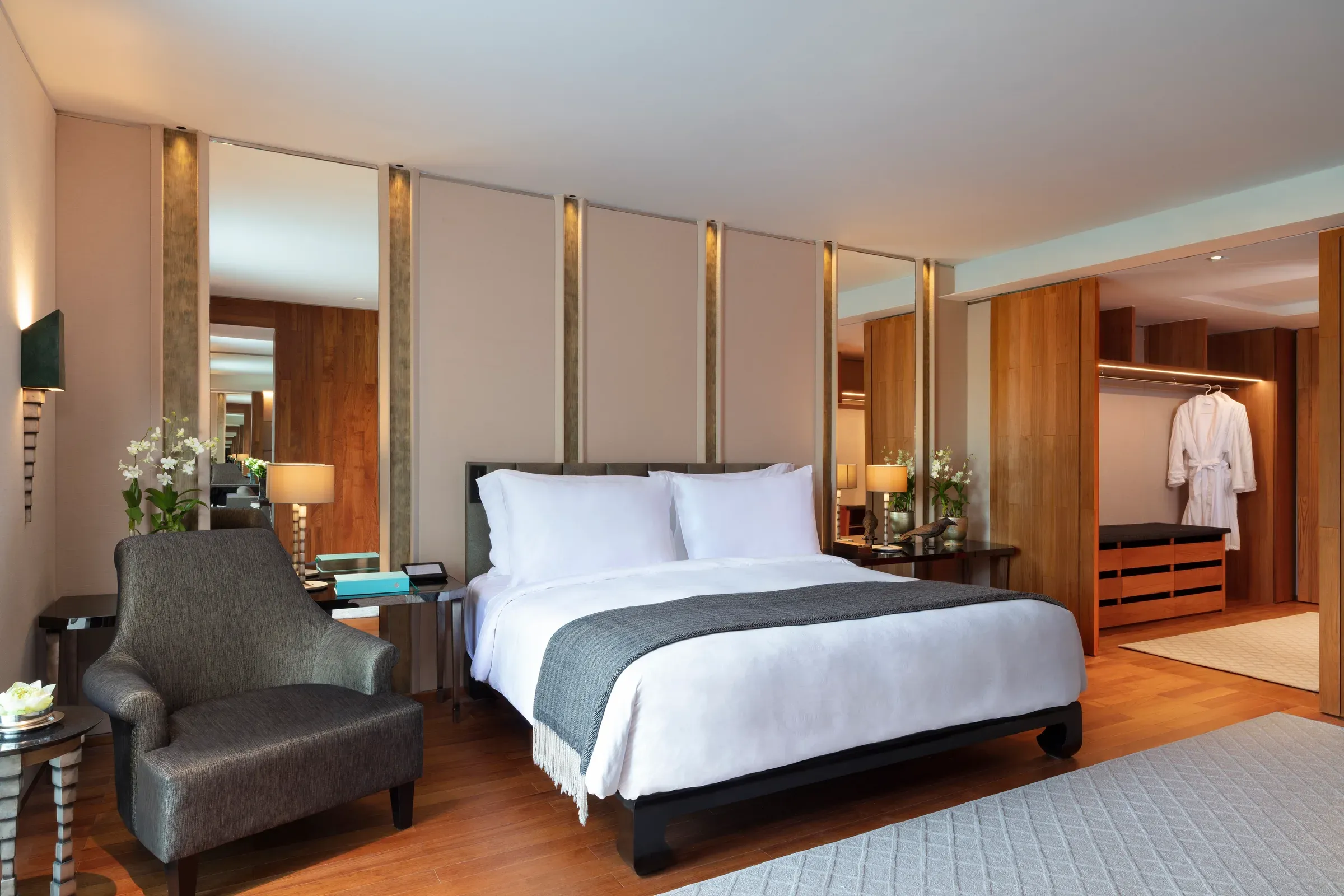
Which room or suite to book at The Sukhothai Bangkok — Main Wing vs Club Wing, all 15 categories from the 38-square-metre Deluxe to the 198-square-metre Sukhothai Suite, with sizes and a decision.
A VIAIVE planning visual used to support comparison, routing, and stay decisions.
19 July 2026
VIAIVE verifies current reservation status, chef or programme changes, and neighborhood fit before naming a dining decision.
Use VIAIVE trip request when the stay, room category, routing, or protection choice needs human review.
Most of luxury Bangkok climbs. The Sukhothai Bangkok spreads instead — chedis, colonnades and lotus ponds across lush Sathorn grounds. A companion read on why the low-rise, garden-and-pond argument still holds.
Bangkok, as a luxury proposition, mostly climbs. The city's marquee hotels tend to announce themselves vertically — a lobby on a high floor, a pool cantilevered over the skyline, a view sold by altitude. The Sukhothai Bangkok makes the opposite argument. It spreads. And the more time you spend thinking about what a Bangkok stay is actually for, the more that horizontal argument holds up.
Bangkok, as a luxury proposition, mostly climbs. The city's marquee hotels tend to announce themselves vertically — a lobby on a high floor, a pool cantilevered over the skyline, a view sold by altitude. The Sukhothai Bangkok makes the opposite argument. It spreads. And the more time you spend thinking about what a Bangkok stay is actually for, the more that horizontal argument holds up.
The hotel sits at 13/3 South Sathorn Road, in the Thungmahamek pocket of Sathorn — the capital's central business and embassy district. It is a serious, quiet address: close to Lumpini Park, a short move from Silom Road, within reach of the Chao Phraya River, and rail-connected through BTS Sala Daeng and MRT Lumpini. On paper that is a location built for a tower. What sits on it instead is a low-rise property that turns its attention inward and downward — to courtyards, colonnades, and water — rather than up toward a skyline it could easily have chased.
That choice is the whole point. In a district where nearly every neighbour competes for the same view of the same horizon, The Sukhothai declines the contest and offers something the towers structurally cannot: ground. Real, planted, walkable ground, laid out around reflecting ponds.
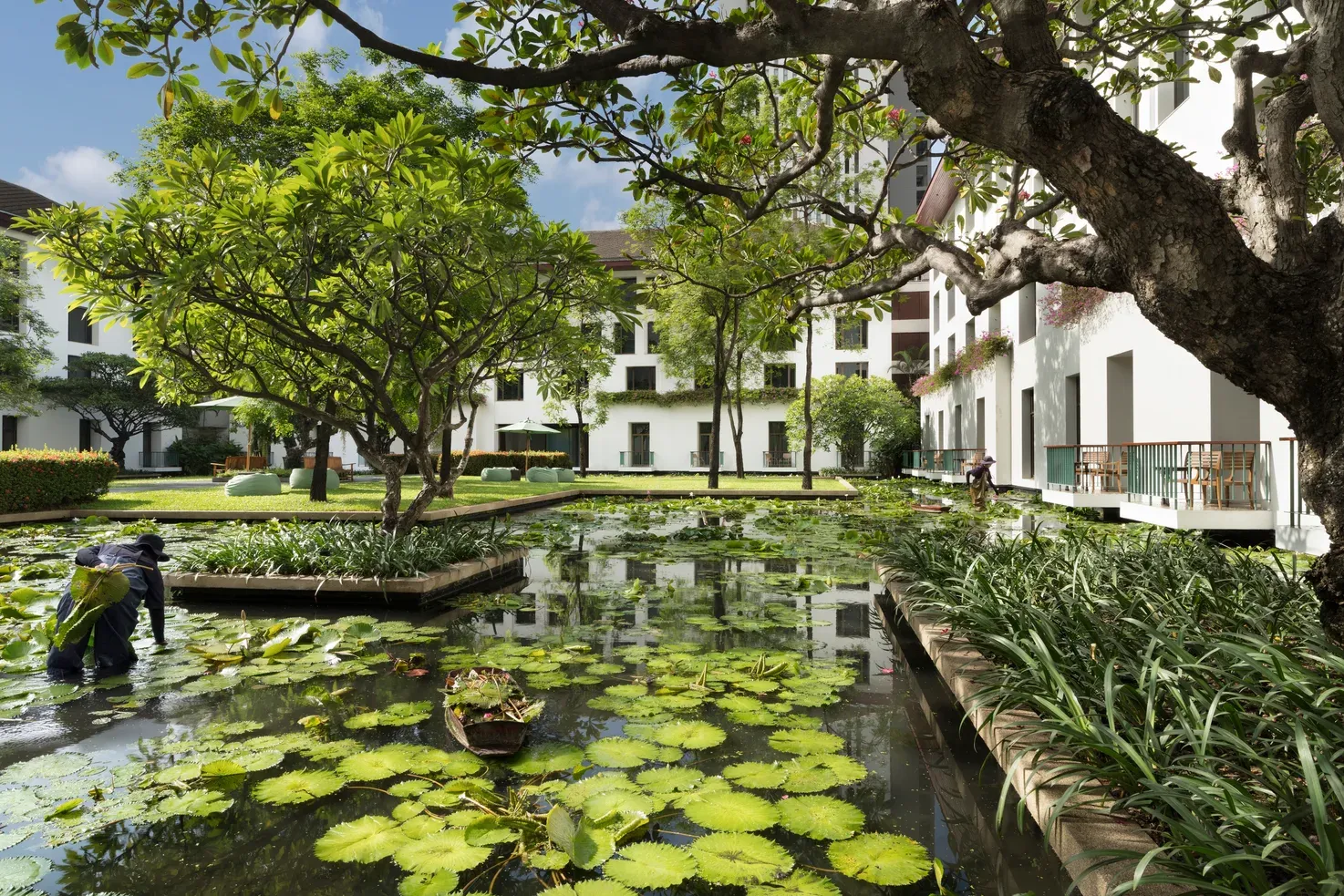
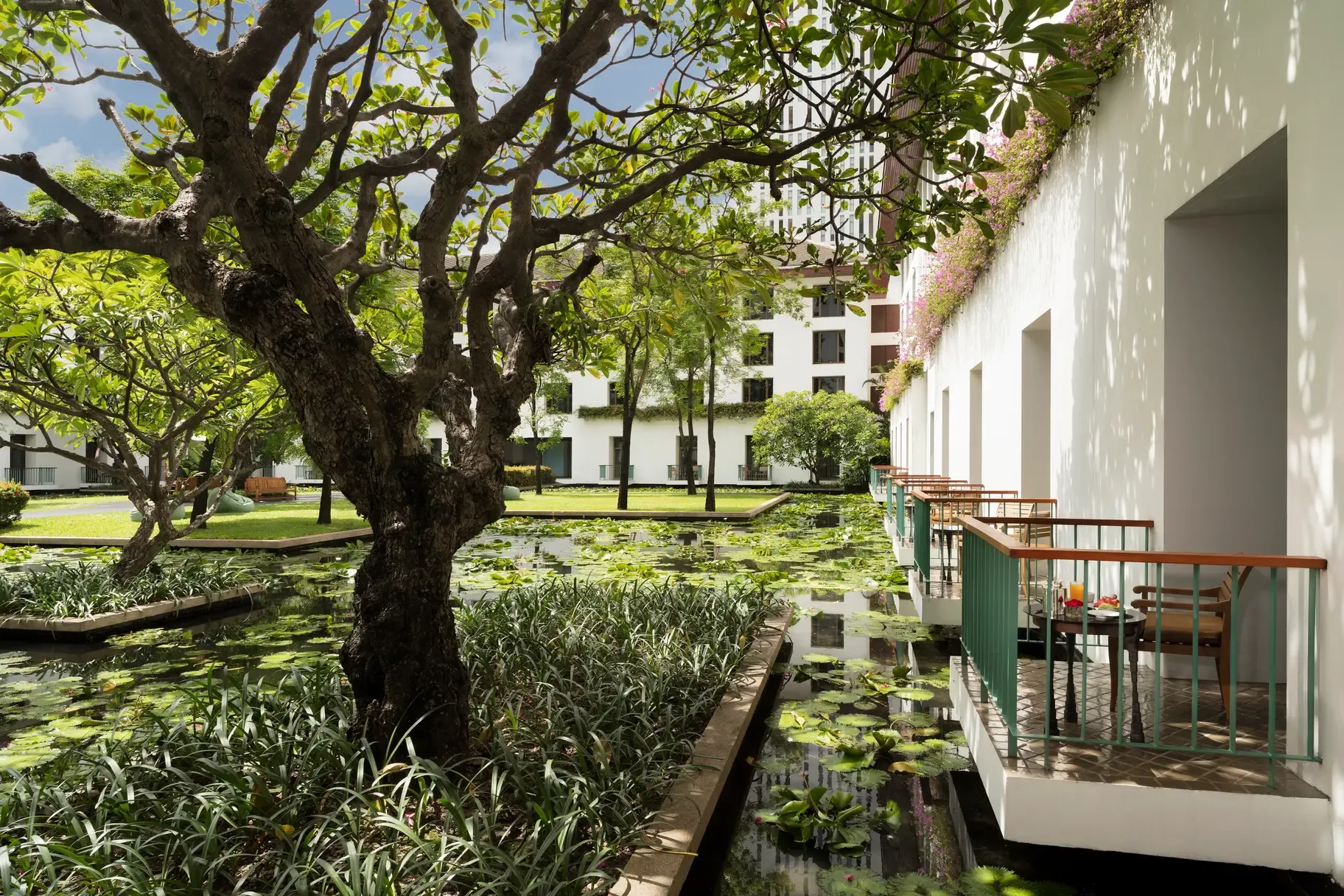
The name is not decorative. The hotel's design draws directly on the ancient city of Sukhothai — the thirteenth-to-fourteenth-century Thai kingdom whose ruined chedis and pagodas remain some of the most recognisable silhouettes in Thai art. The property describes its own architecture, in its own words, as "a careful rendition of the magnificent Chedis and pagodas reminiscent of that graceful age." Those forms are not relegated to a lobby mural. They are built into the grounds as structure — a Chedi Pond among them — so that the reference reads as landscape rather than motif.
This is what separates heritage-led design from heritage-themed design. A themed hotel borrows a few visual cues and applies them to a conventional building. The Sukhothai instead lets the reference dictate the massing: low, spread, organised around water and open colonnade, the way the temple complexes it quotes actually were. The result is a property the hotel frames as "the marriage of tradition with modern sophistication" and an "urban oasis in a living metropolis" — phrasing that would be marketing puff at a high-rise but is, here, a fair description of the physical experience of walking the grounds.
If there is a single detail that carries the whole argument, it is the ponds. The clearest expression of it is Celadon, the hotel's Thai restaurant, which sits — per the hotel — "on terraces encircled by serene lotus ponds." You do not arrive at Celadon so much as cross into it, over and alongside water, into a set of pavilion terraces where the surrounding pools do the work that a skyline view does elsewhere. The kitchen serves "a curated selection of timeless specialties from various regions across Thailand," there are nightly traditional Thai performances at 7:30 and 8:30, and even the signature dessert — the Bua Celadon — takes the pink lotus of the ponds outside as its form. The setting and the plate are telling the same story.
That water-first logic repeats across the property. The Sukhothai Spa is set, per the hotel, in "7,000 square meters of lush gardens," its aesthetic "infused by ancient Sukhothai-style culture," with a Nail Studio tucked inside a Thai Pavilion "embraced by lush greenery." The grounds hold a 25-metre infinity-edged pool. Even La Scala, the Italian dining room, opens onto an alfresco terrace by the water rather than sealing itself behind glass. The common thread is that the hotel keeps placing its best rooms at the edge of ponds and gardens — because that, not altitude, is the view it is selling.
None of this makes The Sukhothai the right answer for everyone. If your Bangkok fantasy is a high-floor room with the city glittering below, this is not it, and you should book one of the towers that does that superbly. If you want a room over the river, this is a Sathorn address, not a Chao Phraya one.
But there is a specific traveller for whom the horizontal argument is decisive: the one who has stayed in the towers, admired the view for exactly one evening, and realised the room could have been in any global city. Heritage design that only a low-rise, ground-hugging property can deliver is not a lesser luxury than a skyline — it is a different and, for some, a more durable one. You cannot walk a view. You can walk a garden, cross a pond, and eat dinner among lotus flowers that the dessert is shaped after.
The Sukhothai Bangkok is, in the end, a thesis about what a city hotel is for. Its answer is that the most valuable thing a luxury property can offer in a dense, vertical, fast city is not a better vantage on the noise but a genuine remove from it — ground, water, shade, and a design language rooted in something older than the skyline. The reason to go is the argument the building itself makes, quietly, every time you choose to look down at the ponds instead of out at the towers.
Seven dining venues at The Sukhothai Bangkok, from lotus-pond Thai terraces to a poolside Italian kitchen.
Ten room and suite categories across the Main Wing and Sukhothai Club Wing at The Sukhothai Bangkok.
Which room or suite to book at The Sukhothai Bangkok — Main Wing vs Club Wing, all 15 categories from the 38-square-metre Deluxe to the 198-square-metre Sukhothai Suite, with sizes and a decision.
Field Intelligence Letter
A short monthly note on hotel openings, route shifts, seasonal timing, and the stay decisions worth making early.
One letter per month. Unsubscribe at any time. No sharing, no resale. Privacy Policy.
When a piece here makes you want to move, write the first few lines.
Plan With VIAIVE ↗